20081208

Obama, please make note!

December 8, 2008
Successful Missile Defense Test Shows Technology Not "Unproven"
by
Baker Spring

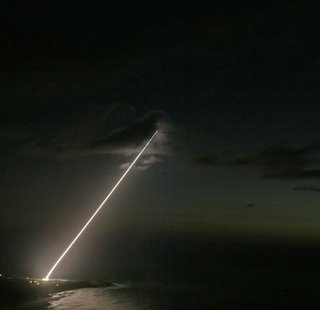
On December 5, the Missile Defense Agency (MDA) performed a successful intercept test of the Ground-based Midcourse Defense (GMD) missile defense interceptor. The GMD interceptor destroyed an incoming ballistic missile launched out of Kodiak, Alaska, in space over the Pacific Ocean. President-elect Barack Obama has stated that he will cut investments in "unproven" missile defense systems.[2] His statement implies that the missile defense program's interceptor systems rely on unproven technology. The December 5 test, along with other MDA tests, demonstrates that the implication behind this statement is inaccurate.

The GMD interceptor, launched from Vandenberg Air Force Base in California, was flown to a point in space in the path of the incoming missile and, by the force of collision, the interceptor's kill vehicle destroyed the missile reentry vehicle. This direct hit, absent an explosive warhead, is called a kinetic energy intercept. Further, a variety of sensor systems were used to track the incoming missile from different locations. These systems included a transportable AN/TPY-2 radar located in Juneau, Alaska; a Navy Aegis ship in the Pacific with its SPY-1 radar; an Upgraded Early Warning Radar at Beale Air Force Base in California; and a Sea-Based X-band radar, also in the Pacific. Finally, the broader missile defense system's command and control system permitted military operators to launch the California-based interceptor from Fort Greely, Alaska.

The kinetic energy intercept technology used in the December 5 test is the same used in most other interceptors now under development by MDA. These include the Patriot PAC-3 system, the Standard Missile-3 sea-based interceptor, the Terminal High Altitude Area Defense (THAAD) system, and the Multiple Kill Vehicle (MKV) system. The latter program seeks to reduce the size and weight of the kill vehicles so that each interceptor missile can carry more than one kill vehicle. Since 2001, MDA has run 47 intercept tests with kinetic energy technology, and 37 have been successful.

Missile Defense Critics

Missile defense critics are likely to dismiss the positive implications of this test for the overall missile defense program. While the results of a single test should not be used to justify either the continuation or termination of any defense technology program, the critics' likely arguments will lack merit.

For example, critics may argue that the GMD system can be defeated by easily incorporated countermeasures designed to confuse the defense. The December 5 test attempted to deploy a "threat representative" target that would have required the interceptor to discriminate between the real target and false targets generated by the incoming missile. The countermeasures on board the target missile, however, did not deploy.[3] Nevertheless, the GMD interceptor is designed to discriminate between real and false targets. The December 5 test raises the question of whether--contrary to the assertions of some critics--such countermeasures are easily accessible to relatively primitive missile powers like Iran and North Korea.

The critics may also argue that the December 5 test was not an operational test and therefore does not justify the fielding of GMD interceptors in Alaska and California. While this criticism is accurate, it fails to acknowledge an important fact: Traditional operational tests cannot be used in the development and fielding of the overall missile defense system because the overall system consists of integrated components that must be built and fielded in order to be tested. For instance, consider the wide variety of sensors and the elaborate command and control system used to support the December 5 test of the GMD interceptor.

Finally, the critics may contend that this GMD interceptor is different from the model that the U.S. is proposing be deployed in Poland and therefore should not be construed as justifying the fielding of the interceptors slated for Poland. The fact is that both the interceptor used in the December 5 test and the interceptors the U.S. is proposing for Poland are both GMD interceptors. The only significant difference between the two is that the interceptors for the site in Poland will include two stages, while the one used in the test has three stages.

Proven Technology

President-elect Obama has stated that fielded missile defense systems' technology must first be proven; the MDA's ballistic missile defense test regime is meeting that challenge. The MDA's technology--kinetic-energy kill vehicles--is being used in an array of interceptors and has been tested on numerous occasions with a 75 percent success rate. President-elect Obama should acknowledge the continuing progress on kinetic-energy missile defense technology and continue to invest in and field the missile defense interceptors that incorporate this technology.

Baker Spring is F. M. Kirby Research Fellow in National Security Policy in the Douglas and Sarah Allison Center for Foreign Policy Studies, a division of the Kathryn and Shelby Cullom Davis Institute for International Studies, at The Heritage Foundation.

20061017

"Every test has failed." News to me!

C.I.R. Press Editorial

UNDISCLOSED
– This post is another in what I foresee as a series of pieces about Missile Defense. No, I am not going to argue the cost of the system because I think it is a high priority and should be on the front burner and get the attention it deserves. I am sure there will be replies saying it is too expensive and that is fine. I am not debating the cost… DoD programs in development are very expensive.

Rob and others have done a good job at putting budget numbers up to try and cement their stance. That is fine, this is my response to those that don’t debate the facts or cost but simply hide behind the uniformed and ignorant line of “every test has failed.” No they have not And this LONG piece is the proof.

“In laying out this picture of the threat our nation faces, I’m reminded of the observation of the Marquis of Salisbury: ‘If you believe the doctors, nothing is wholesome; if you believe the theologians, nothing is innocent; if you believe the soldiers, nothing is safe.’ To extend this to the context of missile defense, let me go two further: If you believe our missile defense critics, nothing will work. If you believe passionate advocates, we can do it tomorrow.”

“The first systems we will deploy provide close-in defense to intercept a short-range missile in its terminal phase. These include the Army’s PAC-3, expected to be operational later this year.”

“Currently we have a small, 120 pound kill vehicle with its own guidance and sensing system. Once lifted into space and pointed in the right direction, on its final leg, it can steer itself into the target and obliterate the warhead by violent impact… This is called hit-to-kill — hitting a bullet with a bullet. Traditional explosives don’t work well in space, and the nuclear tipped interceptors on which we relied 25 years ago — and on which the Russians still rely — have major political and operational drawbacks.”

We’ve achieved success with hit-to-kill not once, but seven times out of the last ten attempts in the past two years, with three different systems. … Our NMD program, for example, has had one hit followed by two well-publicized failures in our three intercept flight tests so far.

I relearned a basic truth in missile defense: that success occurs in private and failure in full view. That they were well publicized is an understatement. Despite our high profile failures, we have made significant progress in developing this system.”

“This is rocket science, and it is difficult, but not impossible. Seven hundred years ago, the current wisdom held that sailors who ventured too far from land would fall off the edge of the Earth. Columbus proved them wrong. Seventy years ago, naysayers were saying that rockets wouldn’t work in space because there was no air to push against. Robert Goddard proved them wrong. Seven years ago, critics were still saying we couldn’t hit a missile in space. We’ve done it. Now they say, ‘OK, you can hit it. But it will be fooled by decoys and countermeasures, so you shouldn’t build it.’"

Lt. General Ronald Kadish, USAF
March 2, 2001

List of tests
Nov 30, 1993 : The Army carried out a successful test of the Extended Range Interceptor. The ERINT collided with the warhead of a STORM target vehicle. This warhead contained a cluster of 38 pressurized, water-filled containers designed to simulate toxic chemical submunitions.

Feb 15, 1994 : An Extended Range Interceptor (ERINT) hit a ballistic missile target vehicle in a test. The target was a nose cone carrying a simulated chemical warhead.


Jan 24, 1997 : A modified Standard Missile 2 Block IVA successfully intercepted and destroyed a Lance missile target. During the test, the interceptor successfully transitioned from radar guidance to its infrared guidance system prior to destroying the target with its blast fragmentation warhead.

Feb 7, 1997 : BMDO and the U.S. Army's Space and Strategic Defense Command carried out a test in which a Patriot Advanced Capability-2 (PAC-2) missile successfully intercepted a theater ballistic target missile. The target missile was fired from Bigen Island, Aur Atoll, toward the Kwajalein Atoll; the interceptor missile was fired from Meck Island in the Kwajalein Atoll and intercepted the target missile over the Pacific Ocean. A Patriot Guidance-Enhanced Missile was also fired at the target, but destroyed itself because the PAC-2 missile had already destroyed the target missile. The target missile had the characteristics of a variant of the Scud missile.

May 12, 1998 : (Failure. But note that some excess costs by such failures were picked up by L-M.)This was the fifth straight failure to intercept for THAAD. The fourth failure earlier had triggered major concern about the program… [resulting in] an agreement with Lockheed-Martin whereby the company would pay the government as much as a total of $75 million in case of later failures in the test program.

Mar 15, 1999 : BMDO and the U.S. Army conducted the Patriot Advanced Capability-3 missile Seeker Characterization Flight (SCF) test. Preliminary data indicated that the test was successful. The objectives of the test included collecting data and analyzing the system/missile capability to detect, track, and close with its target, gathering data on the PAC-3 missile seeker in a flight environment, and evaluating performance closed-loop homing guidance in flight. While interception was not a specific objective of the SCF, the PAC-3 missile did intercept the Hera target missile.

Jun 10, 1999 : THAAD successfully intercepted a Hera target missile. This test ended a string of six failures.

Aug 2, 1999 : The 11th flight test for the Theater High Altitude Area Defense (THAAD) defense missile system was completed successfully, when the THAAD interceptor struck a Hera target missile. For the first time in FT-11, THAAD intercepted a target outside the earth's atmosphere. This was also the missile's first intercept of a warhead that had separated from its booster. The difficulty of the test was further increased because cooling of the target in outer space reduced the ability of the missile's infrared sensors to detect it.

Sep 16, 1999 : The Ballistic Missile Defense Organization and the U.S. Army today conducted a successful intercept test of the PATRIOT Advanced Capability-3 (PAC-3) missile. Test objectives included a body-to-body intercept of a threat representative of a tactical ballistic missile target; a demonstrated capability of the ground system and missile to detect, track, and engage the target, and to collect data to evaluate missile homing functions.

Oct 2, 1999 : BMDO and the U.S. Army Space and Missile Defense Command successfully carried out the IFT-3 NMD test. A modified Minuteman intercontinental ballistic missile (ICBM) target vehicle was launched from Vandenberg AFB, California; and a prototype NMD interceptor was launched approximately 20 minutes later and 4,300 miles away from the Kwajalein Atoll in the Republic of the Marshall Islands. The intercept occurred at approximately 7:32 p.m. PDT and demonstrated the ability of the exoatmospheric kill vehicle to intercept and destroy a ballistic missile target outside the atmosphere. The intercept vehicle weighed about 120 pounds and was equipped with two infrared sensors, a visible sensor, and a small propulsion system. The interceptor's seeker system located and tracked the target and then guided the kill vehicle to a body-to-body impact with the target. The test demonstrated the power of a "hit to kill" interceptor to totally destroy and neutralize a warhead carrying a weapon of mass destruction-nuclear, chemical or biological.

Feb 5, 2000 : A PAC-3 missile successfully intercepted its Hera target. The Hera had been launched from Fort Wingate about five minutes before the launching of the Patriot.

Mar 15, 2000 : The Army completed flight test MFT-3B. In this test, a PAC-2 production missile was fired from a PAC-3 launcher and "successfully engaged" a target that was towed behind a MQM-107 drone. The purpose of this test was to "demonstrate the ability to launch a standard Patriot missile from a PAC-3 launcher and collect reliability data on the production missile round."

Oct 14, 2000 : The Ballistic Missile Defense Organization and the U.S. Army completed Development Test-6 (DT-6) in the Patriot program. This was a complex test involving three targets and two interceptor missiles. The test entailed a simultaneous engagement using a PAC-3 and a PAC-2 missile and two targets, one a ballistic missile, the other an air-breathing drone. One of the principal objectives of the test was to demonstrate system capability to engage and destroy a maneuvering tactical ballistic missile reentry vehicle with a PAC-3 missile and a sub-scale air-breathing target with a PAC-2 missile. The test also aimed to demonstrate PAC-3 seeker acquisition and tracking of a target with a second object present in the seeker's field of view. The targets used in the test were a tactical ballistic target (STORM) and an MQM-107 drone (two drones were actually launched although only one was targeted). During this highly successfully test the PAC-3 missile intercepted and destroyed the STORM target. While the PAC-2 missile did not destroy its sub-scale drone target (MQM-107), the drone did appear to be damaged.

Oct 19-21, 2001 : A poll conducted during this period by the Gallup Organization showed that 70% of the American people favored spending the money needed to build a missile defense system. This was up from 53% in a 14-16 July poll.

Dec 3, 2001 : BMDO and the U.S. Army successfully completed Integrated Flight Test 7 (IFT-7) in the Ground-Based Midcourse Segment portion of the overall missile defense program. This was two straight successes and brought the count in the intercept test series to three successes out of five attempts.

Jun 23, 2004 : In a Missile Defense Agency radar test, an Aegis destroyer, the USS Paul Hamilton detected and tracked the flight of the unarmed Air Force intercontinental ballistic missile after it was launched from Vandenberg Air Force Base in California. The ship-based radar passed data about the in-flight ballistic missile to the Ballistic Missile Defense command and control center at the Joint National Integration Center in Colorado, marking the first time a Navy ship equipped with advanced Aegis radar and a ground missile defense system has successfully passed information about a missile. The ship detected the friendly missile when it came above horizon and tracked it for about 700 miles. The test was an important step in linking the entire missile defense system together.

Jul 29, 2004 : An Arrow missile successfully intercepts a ballistic missile target off the California Coast. The test was part of the joint U.S. - Israeli Arrow System Improvement Program.

Sep 2, 2004 : The Army successfully conducts a flight test of the PATRIOT Advance Capability-3 (PAC-3). The test demonstrated the systems capability to track, engage and intercept a short-range tactical ballistic missile and a low-altitude cruise missile target. A THAAD radar system was used to track the targets during the test.


And ballistic missile defense is not needed?

If every test has failed, how am I able to provide over 10 examples of success? And those are the tests in public knowledge. Those show the specific interception tests, none of the ground, simulation, or just flight tests.

-md

Also reference: Innovation and the BMDS.
Technorati Tags: , , ,

Labels: ,

20090216

Missile Defense WSJ Op-Ed

Obama's Missile Test
FEBRUARY 9, 2009, 11:30 A.M. ET

The Administration wavers on defenses in Europe.

Iran's launch last week of a satellite using a homegrown rocket is another reminder of why Europe needs a missile defense -- and needs to start building it now. Combine Iran's improving missile technology with its nuclear aspirations, and it's a lethal mix. This is especially timely given the debate inside the Obama Administration over whether to walk away from the U.S. promise to provide a defense shield for our European allies.

[Review & Outlook] AP

Iran now joins eight countries with indigenous space-launch capability -- an advance that, on the military side, translates into a step forward for its ballistic-missile technology. The threat isn't immediate, as the satellite was small and lightweight compared to a nuclear warhead, but neither is Europe's missile defense set to be deployed immediately. The reason to start early is precisely to be prepared, and not to have to scramble, if Iran develops its capability faster and the mullahs aren't as benign as some think.

That's why the Bush Administration pushed forward with a Europe-wide missile defense system to be based in Poland and the Czech Republic and built over the next six years. It's also why every NATO country has endorsed the U.S.-led effort. They have done so twice -- first among heads of state in Bucharest in April and again at a meeting of foreign ministers after the U.S. election. NATO also plans to pursue its own missile defenses in conjunction with the Polish and Czech sites.

The question now is whether the Obama Administration will stand by its predecessor's promise or, as is widely anticipated, suspend the European program. On the campaign trail, Barack Obama suggested missile defense was either ineffective or too expensive, or both. His nominee for the third-ranking position at the Pentagon, Michele Flournoy, has indicated that the deployment plans for Europe will be reviewed. In a speech over the weekend at the annual Munich security conference, Vice President Joseph Biden was ambiguous: "We will continue to develop missile defenses to counter a growing Iranian capability, provided the technology is proven to work and cost effective."

Suspending the program would have serious consequences. It would send a signal of American weakness to Iran, which the Obama Administration says it wishes to engage. If the mullahs watch the U.S. back down on confronting its missile threat, who could blame them for assuming it will also back down over its nuclear aspirations?

A suspension would also send a message of American irresolution to Russia, which opposes deploying the antimissile system in countries it considers part of its sphere of influence. This kind of Cold War thinking was on display again last week with the news that Moscow had bribed Kyrygyzstan to close a key U.S. air base for supplying Afghanistan. Backing down on missile defense would only encourage more such Russian behavior.

The U.S.-led missile defense program for Europe is aimed at the Iranian threat, and in no way diminishes Russia's own nuclear deterrent. Moscow knows this, yet it nonetheless threatens to deploy missiles in the Kalingrad enclave between NATO members Poland and Lithuania if the U.S. goes through with the defense system. Moscow has spurned U.S. invitations to participate in the program.

Hillary Clinton's State Department may hope to get more Russian cooperation against Iran in return for disavowing its commitment to Europe. But that's not worth the message it sends about the U.S. willingness to cave in the face of Russian intimidation. Russia may be prepared to cooperate on a modest scale on Iran -- but only if the U.S. forgoes the defense of Europe. That's no bargain.

The biggest fallout of a suspension would be among America's allies in Europe. Poland and the Czech Republic agreed at some political risk to host missile interceptors and a radar. If the U.S. reneges now, these newly free countries will have reason to doubt that they can trust any U.S. security commitments. Other NATO nations are also watching to see if the U.S. will remain a reliable partner against Russia.

Now that he has the responsibility of governing, Mr. Obama may reach a better understanding of the recent technological progress on a defensive shield. Defense Secretary Robert Gates has been a firm supporter of a missile defense for Europe. National Security Adviser Jim Jones, a former NATO commander, knows how important the antimissile system is to the alliance.

The new Administration will also have to make a decision about whether to proceed with the planned expansion of the missile defense site at Fort Greely, Alaska, where 10 interceptors are stationed. Last week's news that North Korea may be planning another test of its long-range Taepodong-2 missile ought to make that an easy call.

Friend and foe alike are trying to take the measure of Mr. Obama, and to test him. Mr. Obama made the nurturing of U.S. alliances a major campaign theme, and, along with trade, the missile defense pact with Europe is the first test of whether he meant it.

(Sorry to my readers, I had this bookmarked and kept meaning to get it up here.)

20090406

SECDEF Gates drops the axes... (UPDATED)

Today SECDEF Gates held his conference with General Cartwright on what was going to live and die in the DoDs future.

I am happy that it seems that missile defense is not going to be ignored. But some of the promising future is no more.
To better protect our forces and those of our allies in theater from ballistic missile attack, we will add $700 million to field more of our most capable theater missile defense systems, specifically the terminal High Altitude Area Defense (THAAD) System and Standard Missile 3 (SM-3) programs.

We will also add $200 million to fund conversion of six additional Aegis ships to provide ballistic missile defense capabilities.

In the area of missile defense:
• We will restructure the program to focus on the rogue state and theater missile threat.
We will not increase the number of current ground-based interceptors in Alaska as had been planned. But we will continue to robustly fund continued research and development to improve the capability we already have to defend against long-range rogue missile threats – a threat North Korea’s missile launch this past weekend reminds us is real.
Deadly aim: Airborne Laser fires tracking laser, hits target
We will cancel the second airborne laser (ABL) prototype aircraft. We will keep the existing aircraft and shift the program to an R&D effort. The ABL program has significant affordability and technology problems and the program’s proposed operational role is highly questionable.
We will terminate the Multiple Kill Vehicle (MKV) program because of its significant technical challenges and the need to take a fresh look at the requirement.
• Overall, the Missile Defense Agency program will be reduced by $1.4 billion.
"Because of its significant technical challenges"?

Are you serious. The plane, happened overnight. Missiles overnight. Aircraft carrier overnight. Everything was so easy. I must say it seems as though Gates has fallen in lockstep with POTUS.

We no longer live by Kennedy logic "we choose not to do these things because they are easy, but because they are hard." We live by Obama logic "if it is hard we don't bother with it, because gosh darn it people like me."

090115-F-0623L-885.jpg

The evasive measures were of no effect and due to this decision we will not have the aircraft and many good people will be losing their jobs. Close to 100,000.
We will end production of the F-22 fighter at 187 – representing 183 planes plus four recommended for inclusion in the FY 2009 supplemental.
[UPDATE:]


[UPDATE:]
In the Hill:
“Cooperation on missile defense is now a critical component of many of our closest security partnerships around the world,” Lieberman wrote in a letter to the president. “We fear that cuts to the budget for missile defense could inadvertently undermine these relationships and foster the impression that the United States is an unreliable ally.

“Moreover, sharp cuts would leave us and our friends around the world less capable of responding to the growing ballistic missile threat.”

Lieberman, a longtime supporter of a robust missile defense program, is the lead signatory on the letter.

Alaska Sen. Mark Begich (D) and four Republicans, Sens. Jon Kyl (Ariz.), Lisa Murkowski (Alaska), Jeff Sessions (Ala.) and James Inhofe (Okla.), also signed it. (An important battery of interceptor missiles is based in Fort Greely, Alaska.)

20090319

Missile Defense is un-proven?

Now we have more success (PDF) coming in the THAAD program the other day (WMV):
March 18, 2009
Successful Intercept in Missile Defense Flight Test

The Department of Defense's Missile Defense Agency and U.S. Army soldiers from the 6th Air Defense Artillery Brigade, Fort Bliss, Texas, completed a successful intercept of a ballistic missile target during a test of the Terminal High Altitude Area Defense (THAAD) missile defense element of the nation's Ballistic Missile Defense System March 17 at approximately 2:30 p.m. Hawaii time (8:30 p.m. EDT) at the Pacific Missile Range Facility off the island of Kauai in Hawaii. Preliminary indications are that planned flight test objectives were achieved. THAAD is a mobile system now in development designed to intercept short to medium range ballistic missiles.

Soldiers of the 6th Air Defense Artillery Brigade conducted launcher, fire control and radar operations, using tactics, techniques and procedures developed by the U.S. Army Air Defense School. The THAAD program is managed by the Missile Defense Agency in Washington, D.C., and executed by the THAAD Project Office in Huntsville, Ala.
Each and every phase of a missiles flight is being countered. Success, I suppose, is failure to President Obama.

Where flip-flopping, missile defense, and the stimulus come together.

20090221

Missile Defense not, President Obama is "unproven."


We currently have two dangers on the horizon: Iran may go nuclear and North Korea may develop a reliable missile capable of reaching the west coast. And what strong words does the United States Government have for such problems? Our Secretary of State calls such actions “unhelpful.” If that is not the understatement of the nuclear age I do not know what is!
To test its intentions, I submitted a detailed proposal to Foreign Ministry nuclear negotiator Li Gun for a "grand bargain" in advance of a visit to Pyongyang last month. North Korea, I suggested, would surrender to the International Atomic Energy Agency the 68 pounds of plutonium it has already declared in denuclearization negotiations. In return, the United States would conclude a peace treaty formally ending the Korean War, normalize diplomatic and economic relations, put food and energy aid on a long-term basis, and support large-scale multilateral credits for rehabilitation of North Korea's economic infrastructure.

The North's rebuff was categorical and explicit. Its declared plutonium has "already been weaponized," I was told repeatedly during 10 hours of discussions.
That was to be expected. The North feels compelled to compete on the global stage in the nuclear realm. My problem comes in the logic people place behind arguments, from the same article:
The strongest argument for this approach is that the United States has nothing to fear from a nuclear North Korea. Pyongyang developed nuclear weapons for defensive reasons, to counter a feared U.S. preemptive strike, and U.S. nuclear capabilities in the Pacific will deter any potential nuclear threat from the North.
Really? So let me get this right you are going to hedge your bets on a regime that has spat in the face of the United States and United Nations time after time and are notorious for NOT keeping their word. That is insanity! If you are going to do that why not go ahead and push for missile defense? If the conclusion is they only have the possibility of 4 warheads, our defense “shield” would not compete against the USSR but it would do just fine against those.

As for the unproven part President Obama:
On December 5, the Missile Defense Agency (MDA) performed a successful intercept test of the Ground-based Midcourse Defense (GMD) missile defense interceptor. The GMD interceptor destroyed an incoming ballistic missile launched out of Kodiak, Alaska, in space over the Pacific Ocean. President-elect Barack Obama has stated that he will cut investments in "unproven" missile defense systems. His statement implies that the missile defense program's interceptor systems rely on unproven technology. The December 5 test, along with other MDA tests, demonstrates that the implication behind this statement is inaccurate.
When it all boils down…it comes to the so called “wasted money” defense. Well you cannot use the “unproven” BS with me, and second the idea that it is too expensive
The White House has asked the Pentagon to cut nearly $2 billion, or up to roughly 20 percent, from missile defense in its fiscal 2010 budget, a prominent advocate of the costliest U.S. weapons development effort said on Friday.

Farming Broadband grants to rural communities

$2 BILLION
Food 13% increase in food stamp payments
$20 BILLION
Commerce Grants to provide wireless and broadband infrastructure to communities, including public computer centers and sustainable adoption of broadband service
$4.3 BILLION
Justice Grants to state and local law enforcement to hire extra police officers
$1 BILLION
Science National Science Foundation research
$2.5 BILLION
Environment Flood control and water management construction, regulation and investigations
$4.1 BILLION
Energy Home weatherization grants to low and middle-income families
$5 BILLION
Energy Advanced batteries manufacturing grants
$2 BILLION
Energy Research and development of renewable and efficient energy technology
$2.5 BILLION
Energy Fossil energy research and development
$1 BILLION
Energy Grants for industrial carbon capture and energy efficiency improvement projects
$1 BILLION
Energy Physics research including high-energy physics, nuclear physics and fusion energy sciences
$1.6 BILLION
Energy Money for federal power marketing administrations in electric power transmission systems
$6.5 BILLION

Environment & Energy $50.8 BILLION

Government Construction, repair and energy alterations to federal buildings and facilities
$5.5 BILLION
Labor Grants to states for youth training, including summer jobs
$1.2 BILLION
Labor Grants to states for dislocated worker employment and training activities
$1.3 BILLION
Health and services National Institutes of Health biomedical research
$9.5 BILLION
Health and services Funding for research comparing effectiveness of treatments funded by Medicare, Medicaid and SCHIP
$1.1 BILLION
Health and services Grants to states for childcare services for low-income working parents
$2 BILLION
Transportation Grants for airport improvements
$1,100

Transportation Grants for capital investments in designated high-speed rail corridors
$8 BILLION
Housing Repairs and modernization of public housing projects
$4 BILLION
Housing Energy efficiency retrogrades to low-income housing, including new insulation, windows and furnaces
$2.3 BILLION
Individual aid Two-year extension of program providing income support and training benefits for workers who lose their jobs because of outsourcing overseas
$1.6 BILLION

Excuse me, but all of that from one stimulus bill and you want to cut $2b from missile defense because it has not been “proven” enough for you? President Obama you are cutting as much from MDA as you are willing to spend to make sure people have broadband? $8b to make sure we have high-speed trains, but hey that pesky shooting down nukes thing…who cares cause we will be able to travel at warp speed on a train right in to Union Station and the awaiting mushroom cloud.

Overboard? Ok, yes but it makes my point that as I go through the stimulus bill I see a LOT of money thrown at “research” and/or “development.” President Obama why are you willing to spend twice as much as you want to cut from MDA, on “investigating floods” and “repairing public housing”? At least in the past when the argument was over a few billion dollars towards MDA most of the spending was more reasonable, even on the left. President Obama, you shoved forward a partisan $800 BILLION SPENDING BILL, yet want to cut a measly $2 BILLION from MDA, 20% of the MDA budget?

At a time when missile defense is making great strides this President may hamstring the entire program enough to make it “unproven.”

President Obama, it is said you can be anything you want. It was never “proven” a black man could be POTUS. Why did you not give up on the “research and development” of that “unproven” idea?

Previous Missile Defense, please read up: 1, 2, 3, 4, 5, 6

20070130

Missile Defense Progress...

C.I.R. Press Editorial

WASHINGTON, D.C.
– Missile defense is again making progress. As noted over at Mike’s America a new article came out with Brigadier General O’Oreilly saying he is confident that the homeland should be defended within a year. This has come on the heels of a successful test at the Pacific Missile Range Facility. As the continual testing goes on of our systems White Sands Missile Range has become unacceptable as a testing ground. The defense missiles now testing cover too much ground and would go out of the range. (This is where “Trinity” the first nuclear bomb was detonated, to give you perspective on the amount of ground these systems cover.)


Complimenting the Patriot (PAC-3) the THAAD can reach out further but is still mobile. People do not realize that much of the missile defense systems focus not only on protecting the homeland but also our interests (military and non-military) abroad.

“The Ballistic Missile Defense System now in development and testing will be capable of providing a layered defense for the U.S. homeland, its deployed forces, friends and allies against ballistic missiles of all ranges in all phases of flight. The higher-altitude and theater-wide protection offered by THAAD provides more protection of larger areas than lower-tier systems like Patriot alone. THAAD can be transported by air to wherever it is needed worldwide, and consists of radar, fire control unit, missile launchers, and interceptor missiles.” (MDA News Release Jan 27)


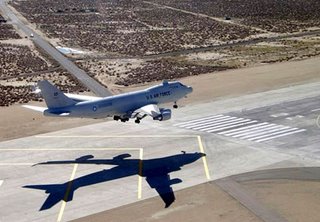
As the flight testing for the airframe continues, the ABL (Airborne Laser) will now fire its weapon in flight. This modified 747 tracks missiles in theater and destroys them after launch (phase 1 of flight).

To show you how the entire system is designed to work, I stumbled across this animation which I am sure many will call science-fiction. It is a pretty good demonstration of the possible results if the MDA is supported. This is in no way an official Government video. However, the components used do exist.

To those who want to post and say “This will never work” or “What a dream.” Well…
This will never work...
What a dream...

Did those things happen overnight? No. Were they free? No. Were there no failures along the way?” Of course there were. Those that want to say MD is expensive and you don’t want to pay for it, fine. Those that want to say “it will never work” : If you had been in charge we would still be taking ships to and fro Europe and around the world.

-md
Other Missile Defense posts on C.I.R.: 1, 2, 3, 4
Technorati Tags:
, , , , ,

Labels: ,

20070223

Missile Defense and Russian Threats.

C.I.R. Press Editorial

WASHINGTON, D.C.
-- Currently the MDA (Missile Defense Agency) has planned positioning some 10 interceptors and radar in Europe to protect our assets and allies on the continent from aggressors such as rogue nations like the DPRK and Iran. Russia is using this as an excuse to come after the United States. The system would have no impact on Russia due to the location of the interceptors a missile launch from Russia would be off and too far in to its flight before the radar could pick it up, establish a flight trajectory, and fire an interceptor. That and the fact, I will mention again later, that 10 interceptors can not take out thousands of missiles and warheads that Russia has.


It is only a matter of time before we start hearing the people that say “the end is near” and start the claims that President Bush is trying to bring the world to the brink of Nuclear War. This is just a joke. I have to walk a fine line when commenting about MDA activities but this sentence really got to me:

“Frank-Walter Steinmeier says, because of the strategic nature of the project and its close proximity to Russia, Washington should have included Moscow in the talks from the beginning.”
Really, did Russia keep us in the talks when they developed “stealth” cruise missiles, or how about selling arms to Iran, or launching Iranian satellites in to orbit? Some of you may not remember but it was recently that Russia was firing off a new cruise missile with large range and Putin touted the fact that this missile was “stealth” and thereby could penetrate any missile defense system. Think about it, who else has missile defense systems? Basically the United States and Israel. The “ex-“spy turn leader threatened the US between the lines. Why are we not supposed to respond? In addition Russia has sold state of the art surface-to-air missiles (SAMs) to Iran, perfect timing at a time where a possible (I say possible) air strike might be necessary to stop Iran who again yesterday spat in the faces world via the U.N. And SECSTATE Rice came back with a semi-strong statement:

"I think it is unfortunate that the Russian head of strategic rocket forces would come out and say that somehow Poland and the Czech Republic would now be on the target list of Russia. I think that was an extremely unfortunate comment," Rice said in Berlin after talks with German Foreign Minister Frank-Walter Steinmeier.”
So to the “it’s America’s fault” crowd please explain to me how our use of DEFENSIVE weapons causes the once super-power to threaten essentially the U.S. and other countries is US causing the situation. That is like looking at two people in a street fight and blaming the whole thing on the guy that doesn’t wasn’t to fight and is only putting his arms up to block incoming punches. This mindset, via the KGB agents government makes me really think that Cold War II is on its way.

In addition for Russia to be complaining is a joke! This is to prevent DPRK or Iran who have a minimal number of weapons and a minimal number of delivery missiles. And I in turn go to the good SECSTATE to make the point:

“Anyone who knows anything about this will tell you there is no way that 10 interceptors in Poland and a radar site in the Czech Republic are a threat to Russia, that they are somehow going to diminish Russia's deterrent of thousands of warheads."

Yesterday, Lt. General Obering (Director of Missile Defense Agency) spoke to the press regarding this issue.

“Here’s what we’re concerned about,” Obering said. “We know that rogue nations such as North Korea and Iran are very much interested in ballistic missiles and that technology, not only for the operation of these missiles, but to be able to have them for coercion and for intimidation purposes.”
In General Obering’s comments he commented upon what we always hear from the lefties, the misconception that MD does not work… but as he said, that is false and there are the test results to prove it. 24 successful hit-to-kill tests since 2001, that does not sound like a “failure” to me. Here is a link to the most recent missile defense piece I have done which in turn includes links to all other MD articles I have done. In addition please read Mike’s America Dem Not Serious About Missile Defense.

Labels: , , , ,

20090304

Heritage leading on MDA as always...

Missile Mayhem
By James Carafano
When is a negotiation not a negotiation? And a rejection not a rejection? Apparently in the Alice in Wonderland exchange of notes and replies between the United States and Russia.

President Obama sent a secret letter to the Russian president suggesting if Iran did not have a nuclear and ballistic missile program the United wouldn’t need to build a missile defense shield. The Russians replied that they had no interest in trading anything to prevent the United States from building missile defense sites in Europe. They were just dead-sent against it. Once the letter became public both rejected the suggestion that they were negotiating over missile defense as a bargaining chip.

That left most analysts like myself speechless–did they really believe anybody believes this was anything but a clear rebuff to the new president. As I told the USA Today, “I’m not sure what the administration is doing. You can’t negotiate away something that doesn’t exist. It’s just nutty.”

To our dismay, the administration follow-up was even stranger. White House spokesman Robert Gibbs said Obama would weigh a number of factors in deciding whether to proceed with a missile-defense system, “including whether or not the system worked and the cost of the system.” By sending signals it does not take missile defense seriously, the White House is only encouraging the Iranians to speed-up their missile and weapons programs and the Russians to demand more quid pro quo in any negotiations with the United States.

Yet, folks continue to believe the administration “hitting the reset button” rhetoric means something. “Michael Mandelbaum, a professor at The Johns Hopkins School of Advanced International Studies, said Obama’s “charm offensive” is not likely to work with Iran, Syria and other U.S. adversaries. But pursuing it with Russia, he said, is the right course….If we could trade these (missile) deployments for serious Russian pressure on Iran” to stop its nuclear ambitions, he said, “that would be a very good trade for us.”

Hello, the Russians have already said “No!” to this. And with good reason…they are selling nuclear technology and air defenses to protect nuclear sites to the Iranians. Even if the Russians said “Yes” the Iranians would say “No.” They have no interest in giving up their weapons program as a favor to the Russians. And even if the Iranians said “Yes” it would take years to negotiate a verification system to prove they really were disarming…and in that time could covertly build missiles and nuclear weapons…and if we stopped building missile defenses now we would be caught with no defense.

I wish the folks at the White House would spend even five minutes watching 33 Minutes, our documentary about the missile threat. If they did they might be less inclined to dangerous diplomacy, that leaves America and its allies hostage to foreign missile threats while folks in the administration engage in talks that will likely only make us less not more safe.

20061012

Innovation and the BMDS

C.I.R. Press Editorial

WASHINGTON, D.C. –
One of the biggest issues that people bring up is that the Ballistic Missile Defense System is a waste of money because it doesn’t work. I have two reactions to that assessment. Thank God we have not yet had to prove it via battle-test. Second, it does work. People fail to realize this is a system including land, air, and sea assets. Have there been failures in the testing of some assets, yes. I will not try to hide that. Cars were failures, the Titanic sank, many things have failed does that mean we end any and all usage? I liken it to airbags. Airbags are expensive things, you pay for them to be in your car… and likely will never ever use them. But in the rare event you need them, they are there for you. Think of the BMDS as the nations airbags. Just one component of the over all safety features in the car that you pray you never have to use. As well as insurance… my driving and added training makes me confident that I don’t need insurance. Law requires it, but even if it wasn’t required I will still spend the money knowing I will never use it.

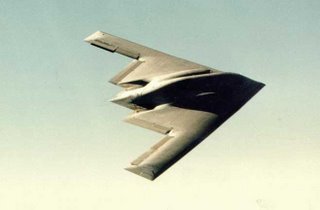
Over the times of civilization there had come times when great leaps in technology were thought to be ahead of their time. Maybe others just give up but we are America, we should not be giving up… sometimes we do. For example look at the following photographs.


The “flying wing” B-35 was a dream in an genius’s head that was developed and went from prop power to jet power in the B-49. As time went on people said it can’t be used, or that it was a generation before its time. His love was gone and Northrop left the aviation industry. Only to later in his life find out about the newest and possibly most technologically advanced aircraft in the world… the B-2 Spirit was the spitting image of his work. What took computers today he had essentially done with pen, paper, and brains so many years ago.


So for those against the missile defense systems why wait? Why put off something that is inevitable? Doing so only leaves open another way of attack from country or terrorists elements. I personally think we need to spend the money on defense before other things. Why in God’s green earth did we allow federal money to be used to repair the stadium in New Orleans? Any one that wants to talk about the wasting of money I would really like an explanation as to why federal money to a stadium is more important than say… BMDS?

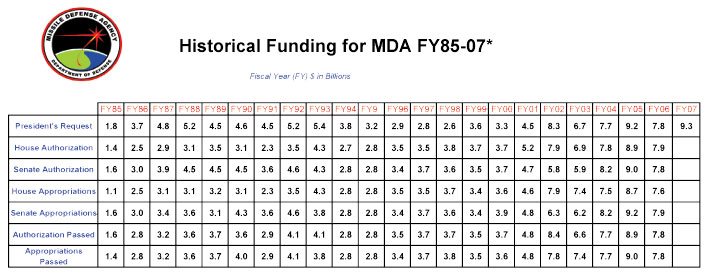
So let us look at the requested amounts and how much they are granted:

So let’s see who really was for and against BMDS. Mid to late 90’s the President asked for less money, but by ’96 Congress started to provide more money than even the Democratic President requested. Then in ’02 the President pushed for more money and congress delivered. Sometimes giving a little more or little less. But with the threat obvious those with the safety of the nation looked to the future and wanted to prevent any horrific attack a nuclear armed missile would unleash.

It was nearly 30 years between the end of the YB-49 and the recall and start of the B-2 Spirit. Missile defense has been in the making since before the YB-49, around the time of the first V-2 rockets terrorizing England. Closer to our time it was in 1976 that the Safeguard system was closed and for some time we had no defense. As so many on the left say today “President Bush needs to listen to the generals” that is exactly what President Reagan did in 1983 when he received a unanimous recommendation from the Joint Chiefs of Staff to implement the SDI program.

In 1993-94 there was a huge drop in funding for missile defense under President Clinton. He split the systems up, taking some of them off the defense acquisition table. Funny how that was timed in the years surrounding our good friends at the New York Times placing an article on their front page that said the HOE (Homing Overlay Experiment, one version of a possible new system) was not actually a success. This was a test done in June of 1984 yet the article appeared on the front page in 1993. But the test was proven not to have been rigged by the Pentagon and General Accounting Office (GAO) when they refuted the article.

Then there are the complaints from the left that President Bush is just leaving problems for the next President. Well it was on September 1, 2000 that President Clinton announced he was too worried about violating the ABM Treaty so he would not be deploying the system to Alaska. That is right, he was overly concerned about everything BUT the safety of America, and in that speech left this problem to the next President.

Thankfully President Bush saw the need for the system and if it required a change in policy to protect the US, then that is what needed to be done. So on December 13, 2001 he announced that the US would withdraw from the ABM Treaty. He also realized that over the years we would develop weapons systems and in the effort to make them perfect spent so much time testing them that they were obsolete when they reached the battlefield. So he changed some regulations allowing the typical ORD to be avoided and for new systems to be put online as quickly and as safely possible.

“The deployment of missile defenses is an essential element of our broader efforts to transform our defense and deterrence policies and capabilities to meet the new threats we face. Defending the American people against these new threats is my highest priority as Commander-in-Chief.”
— President George W. Bush, December 17, 2002

With Iran trying to acquire nuclear weapons and missile technology, North Korea trying to develop nuclear technology and improve upon their ICBMs… and announcing they will have to launch missiles at the US if sanctions are imposed. How can anyone not see the threat and want to safeguard against it? The missile threat has been around far longer than our terrorist threat. We must guard against both and not open ourselves to a missile attack because we divert all resources into other threats. That is a recipe for disaster, and with nukes… one hell of a disaster.

-md

Technorati Tags: , republicans, missile defense, BMDS, ICBM, nuclear, North Korea, Iran, ABM Treaty, President, military, Reagan, Bush, Clinton

Labels: ,

20081111

Fear Propaganda, it is not!

There are those out there that are clueless and will believe this is just “fear propaganda.” They are just placing themselves and the rest of us in danger. After years of support of missile defense, I am now worried about its future. Even under President Clinton, missile defense was funded. POTUS-E Obama wishes to end support of missile defense that does not work. Well that is why it is called “in development.” We did not fly overnight either and I hope Obama realizes it. We had finished the commitments to placing the radar and interceptors in European allies countries…will this be reversed under an Obama administration that fails to understand the dangers and national security? Many of his advisors are Clinton era folks who seemed to brush off a figure named Osama Bin Laden.

We have a world building momentum…

“Cuban President Raul Castro will visit Russia next year, the Kremlin said on Tuesday, in a new sign that Moscow is reviving a Cold War-era trade and military alliance."

There was a time when the United States had missiles much closer than 33 minutes away. Now those ties are growing again.

“Moscow was Havana's main benefactor during the Cold War but the collapse of the Soviet Union in 1991 dealt a heavy blow to Cuba's economy. Relations soured in the 1990s.

Medvedev said the two countries had "overcome that pause" and contacts were now intense. Perez Roque handed Medvedev an invitation to visit Cuba, NTV television said.”

I am the first to admit there is plenty I do not know about, but missile defense is vital to our national security. I support it, and believe in the need to help our allies in Europe defend themselves from the point in time when Iran loses its temper. I do not think we should stand by as the USSR places OFFENSIVE missiles aimed at our European allies. If they are willing to do it there why do you think they are reestablishing ties in Latin America?

“Moscow has been taking a greater interest in Latin America, a strategy that political analysts and diplomats say has more to do with selling arms to the region than with flexing its muscles under the nose of the United States.”

I disagree and say they are flexing muscles. As Iran fires new missiles, arms sales increase and our enemies coordinate their development of delivery vehicles, and warheads.

Other pieces on Missile Defense: Missile Defense

20070530

USSR Watch 2


C.I.R. Press Editorial

UNDISCLOSED –
The Soviet Union is once again ratcheting up the rhetoric aimed at the US like they did in the Cold War. The only problem is they are not the force they were then. Between the fall of communism and their grip on vast areas they failed. However, as the months pass the (need I remind you) “ex-“KGB President Putin has taken steps back towards the good ol’ days. The steps he has taken have even had some on the left, and those that hate America peeved.

It was over a year ago that the Soviet President was announcing to the world that they developed a new stealth cruise missile that is capable of penetrating any missile defense system. Ok, so quit your bitching about the US getting allies (don’t you lefties like them) to allow us to place a nominal number of interceptors that could counter a rogue missile launch towards the US or Europe. Putin claims our plan will turn Europe in to a “powder keg.” Only thanks to you, Mr. Putin.

Quite frankly I don’t understand why 10 missiles with hit-to-kill vehicles on them (no explosives involved) would concern you. I cannot remember the exact quote but he went on to speak about the protection of Europe and how important that is. I would say that stopping missiles against hitting the European countries is a good way to start that protection. As I have said an uncountable number of times 10 interceptors in no way counteracts the Soviet Union’s ICBMs! We fought that war and won. Although it seems as though we didn’t, we didn’t get rid of all the cockroaches and left one communist loving spook that happen to become President.

And to President Putin, I ask if your super-duper special missiles are so amazing then why the concern over our missile defense? We acknowledge that our system cannot defend against a full attack from the USSR. So either your super missile is not so super. Or you want to cause problems. Tie that in with the fact that a year ago while yapping about your new missile you brought up our “ally” Chirac and went over the system with him. Oh also at the time you were going to be inviting Hamas to come for a slumber party.

Now why would I have any concern of the Soviet Union complaining about our missile defense system when he is meeting with terrorist organizations, detailing secrets to our enemy Chriac, and boasting of new missiles left and right able to penetrate ANY missile defense system the US has and/or develops?

OH YEAH (just remembered)...

While we are talking about creating "powder kegs" President Putin, how about YOUR sale of SAMs to Iran at a very interesting time!?

Labels: , , , , ,

20061025

Mobile sea-based defense.


C.I.R. Press Editorial

WASHINGTON, D.C.
– I apologize I have not been around for a week but I don’t always have enough time to throw up a “gone fishing” message when I need to leave town. I cannot remember at this moment who it was that asked about “when a working missile defense system would be operational”, and there is much more to the entire system but my focus has been much on the land based assets. But here is another aspect and it is about time I give a little credit to the Navy. Here is another example that we are striving towards a successful system and you are getting your monies worth.


By year's end, the Navy will have at least six ships able to track down and destroy ballistic missiles in space.

As it works to expand a decade-old program, the Navy is upgrading 18 guided missile cruisers and destroyers, including two in Norfolk,
to counter missile threats.
...

In an international crisis, the United States has traditionally relied on aircraft carriers to respond, according to Rear Adm. Brad Hicks, director of the Missile Defense Agency's Aegis Ballistic Missile Defense program.

Now, he predicts, "it won't be too long - in a couple of years - when the national command authority will ask: 'Where are the Aegis ships?' "
...
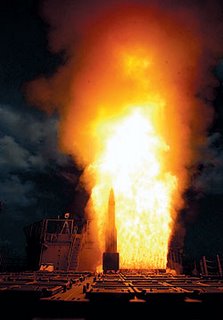
The guided missile cruiser Shiloh, formerly based in San Diego, was able to detect, track and destroy an incoming missile at least 100 miles out in space during a test in June, Hicks said.
...
The Navy will have converted 10 Aegis-equipped destroyers to long-range tracking ships by the end of this year. However, they will not be able to shoot down incoming missiles until they obtain additional upgrades. Six other vessels, to include guided missile cruisers, called "engagement ships," will be able to track and shoot down missiles.
So many things are making progress and success is being had. One of our main problems now is one we had for years with everything military but especially shown in aircraft. Speed. Props turned to jets. Planes became more aerodynamic and faster. And how was the best way to over-fly the USSR? Design the SR-71 to just outrun any G-A missiles. Well now we have to hit missiles. So the hurdles at hand are designing faster missiles, a problem which is moving along and being solved as we speak.

-md


Also reference: Innovation and the BMDS, "Every test has failed." News to me!
Technorati Tags: , , , , ,

Labels: ,

20080406

Defend the homeland, missile defense.

Vandenberg-Reagan


“What if free people could live secure in the knowledge that their security did not rest upon the threat of instant U.S. retaliation to deter a Soviet attack, that we could intercept and destroy strategic ballistic missiles before they reached our own soil or that of our allies?” - President Ronald Reagan, March 23, 1983

It seems as though the paranoia that came hand in hand with the Soviet Communist rule has returned. For a long time I have documented President Putin’s hostile words towards us, his added military actions in our direction, sales of SAMs to Iran, and fury over missile defense.

Our Constitution charges the Federal government to “provide for the common defense” and that is why I have been behind POTUS on making sure it becomes reality. Why would it be hard to understand one good idea to defend the country would be to prevent nuclear warheads from detonating over our heads? Does it stop there? Of course not, however it is one piece of the puzzle.

In the most recent trip by POTUS, NATO has invited Croatia and Albania to join. Of course as more countries join Putin has become more and more tense. I suppose it is not good for him to not be able to manhandle countries, knowing they have others willing to support them. Who supports Russia? They make friends by selling arms to Iran and communist regimes. My tears are just that of sweet joy hearing Putin complain over our plans for radar and interceptors in Europe.

Why so? He knows full well that the interceptors cannot impact his missile force, nor could the limited number of 10 interceptors threaten Russia’s vast ICBM power. In addition the radar used is directed in a certain position, meaning it is not going to be doing this so called “invasion” on Russian national security. So Putin cries over two problems…THAT ARE NOT REAL! If you have to resort to making up problems either things are going very well for you, or you are trying to misdirect people from looking at the real problems. I feel he is trying to misdirect people away from the fact he is making an effort to restore the Soviet ways.

As we have Iran pushing forward in nuclear development, Israel took out a site in Syria where nuclear work was being done with the help of North Korea. As Israel now reportedly confirms this to Japan it only heightens the reasoning for having a system to protect out allies in Europe (and the USA as their range increases in future years) from ballistic missile threats and ICBMs from the middle east.

Another welcomed change is that of congressional democrats not using there time to DESTROY the idea of missile defense. In the past you had a variety of democrats either attacking the overall idea of MD, saying it was too expensive, or of course that it didn’t work. Tests continue to show progress and success. Just think the most recent GAO numbers say that out of 20 tests, 80% were successful. Oh, and of the 20% failed, half of them failed because there was a failure on part of the target missile. So in reality 80% succeeded, and 10% failed due to the missile defense interceptor. I’d like to ask congress if they manage to get 80% of their proposed legislation through.

*As always Mike's America can provide added details over the week's events.

20090330

Missile defense, now is the time!

MDA_Brookes
WMD and ballistic missile proliferation trends make the case for a missile shield.
by Peter Brookes

Just 10 years ago, there were only six nuclear weapons states. Today, there are nine—with another country knocking on the door of the once-exclusive atomsplitting
club.

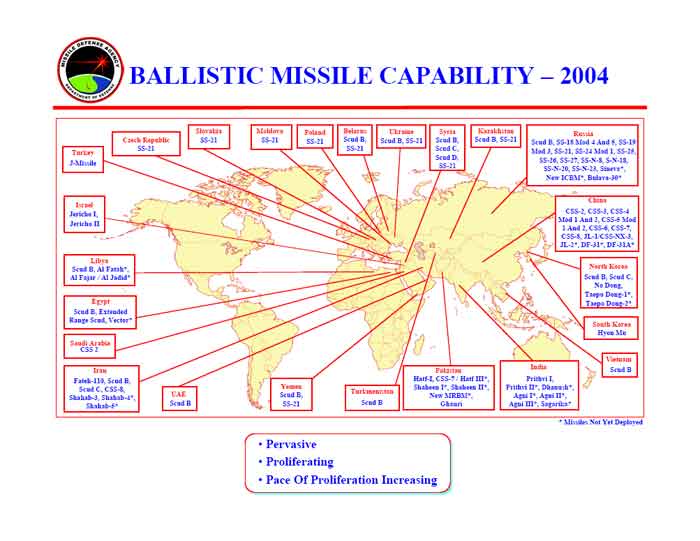
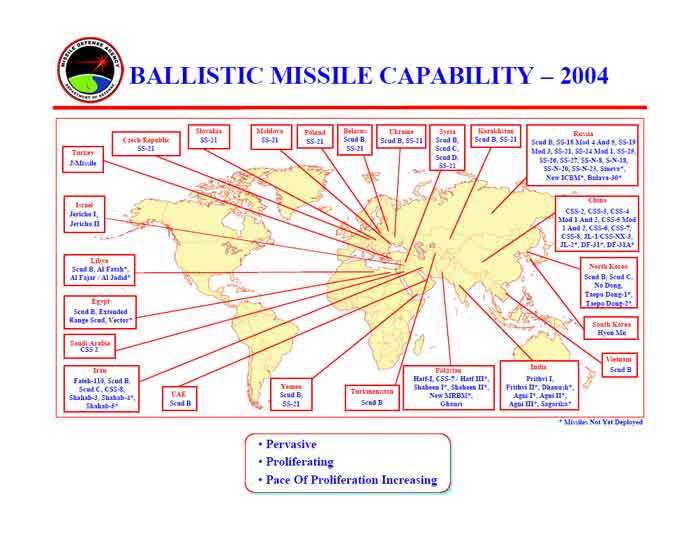
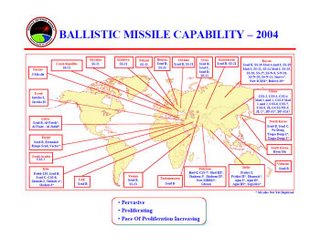
Twenty-five years ago, nine countrieshad ballistic missiles. Today there are nearly 30—not to mention that ballistic missile testing hit record post-Cold War highs just last year.

Clearly, the ballistic missile and weapons of mass destruction (WMD) proliferation trend isn’t positive. Despite this, a missile defense system that would protect the homeland, American troops overseas, allies and friends remains a controversial idea in some corners of American thought.

While the George W. Bush administration took significant steps to develop sea- and land-based missile defense systems to thwart the growing threat, development of the missile shield is far from complete. Considering just Iran’s nuclear efforts, North Korea’s assistance to Syria, and robust Russian and Chinese arsenals, it’s imperative
that the White House and Congress support missile defense programs to close a gaping hole in our national security.
Read the entire 6 page piece here in PDF form.

20090302

Obam-ing the Military. Yikes!

ObamaBumper

Some of the key portions from the following piece in the Wall Street Journal. (h/t Wordsmith) Ok, scratch that... the entire thing is important and I always worry about articles disappearing off sites. So here is the entire piece:

Declining Defense

Obama's budget does cut one federal department.

For all of his lavish new spending plans, President Obama is making one major exception: defense. His fiscal 2010 budget telegraphs that Pentagon spending is going to be under pressure in the years going forward.

The White House proposes to spend $533.7 billion on the Pentagon, a 4% increase over 2009. Include spending on Iraq and Afghanistan, which would be another $130 billion (or a total of $664 billion), and overall defense spending would be around 4.2% of GDP, the same as 2007.

However, that 4% funding increase for the Pentagon trails the 6.7% overall rise in the 2010 budget -- and defense received almost nothing extra in the recent stimulus bill. The Joint Chiefs requested $584 billion for 2010 and have suggested a spending floor of 4% of GDP. Both pleas fell on deaf ears. The White House budget puts baseline defense spending at 3.7% of GDP, not including Iraq and Afghanistan. The budget summary pleads "scarce resources" for the defense shortfall, which is preposterous given the domestic spending blowout.

More ominously, Mr. Obama's budget has overall defense spending falling sharply starting in future years -- to $614 billion in 2011, and staying more or less flat for a half decade. This means that relative both to the economy and especially to domestic priorities, defense spending is earmarked to decline. Some of this assumes less spending on Iraq, which is realistic, but it also has to take account of Mr. Obama's surge in Afghanistan. That war won't be cheap either.

The danger is that Mr. Obama may be signaling a return to the defense mistakes of the 1990s. Bill Clinton slashed defense spending to 3% of GDP in 2000, from 4.8% in 1992. We learned on 9/11 that 3% isn't nearly enough to maintain our commitments and fight a war on terror -- and President Bush spent his two terms getting back to more realistic outlays for a global superpower.

American defense needs are, if anything, even more daunting today. Given challenges in the Mideast and new dangers from Iran, an erratic Russia, a rising China, and potential threats in outer space and cyberspace, the U.S. should be in the midst of a concerted military modernization. Mr. Obama's budget isn't adequate to meet those challenges.

That means Secretary of Defense Robert Gates faces some hard choices when he finishes his strategic review this spring. An early glimpse will come soon when the Pentagon must decide whether to continue to purchase more Lockheed F-22 Raptors. The Air Force is set to buy 183 of the next generation fighters, though it wanted 750, which would be enough to give the U.S. air supremacy over battlefields over the next three decades. Now the fighter may be prematurely mothballed.

Weapons programs, such as missile defense or the Army's Future Combat Systems, are also in danger. Others have been ridiculously delayed. The Air Force flies refueling tankers from the Eisenhower era. Mr. Obama's own 30-something Marine One helicopter is prone to break down and technologically out of date.

The Pentagon shouldn't get a blank check, though much of its procurement waste results from the demands made by Congress. Mr. Gates has also rightly focused on the immediate priority of irregular warfare and counterinsurgency. But history also teaches that a nation that downplays potential threats -- such as from China in outer space -- is likely to find itself ill-prepared when they arrive.

The U.S. ability to project power abroad has been crucial to maintaining a relatively peaceful world, but we have been living off the fruits of our Cold War investments for too long. We can't afford another lost defense decade.